Regenerative Travel in Singapore: What Comes Next for Taiwan’s Hospitality Industry? | Washcan Journal | Washcan瓦士肯
Regenerative Hospitality in Taiwan: Lessons from Singapore
Singapore is transforming sustainable hospitality through certification, carbon management, industry collaboration and long-term tourism policy. Taiwan does not need to replicate Singapore’s model. Its opportunity lies in connecting hotels with local manufacturing, agriculture, food, communities and travel experiences. This article explores how Taiwan can build a measurable pathway toward regenerative hospitality—one in which every stay creates more value for the places, people and industrie
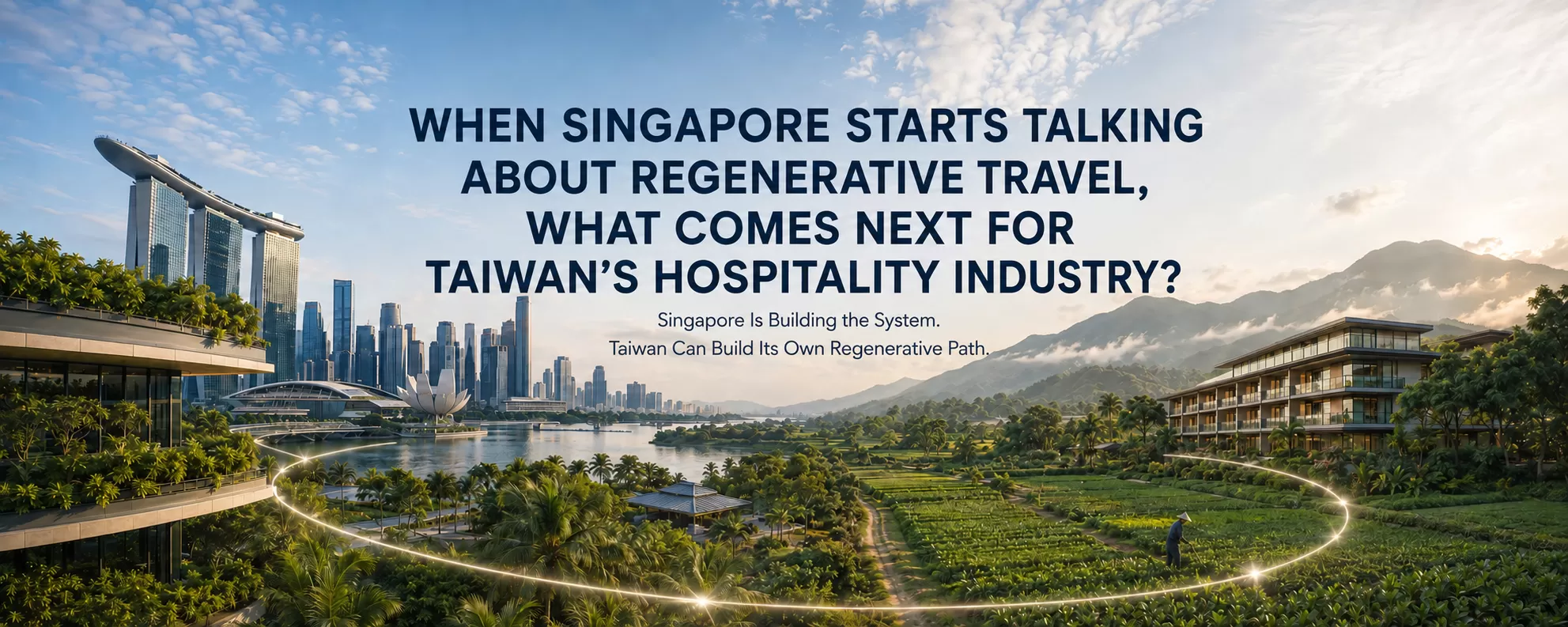
When Singapore Starts Talking About Regenerative Travel, What Comes Next for Taiwan’s Hospitality Industry?
Singapore Is Building the System. Can Taiwan Build Its Own Regenerative Path?
Singapore is strengthening the sustainability competitiveness of its hospitality industry through policy frameworks, certification, carbon management and international platforms.
Taiwan brings a different set of strengths: land, agriculture, manufacturing, food culture and deeply rooted local communities.
As regenerative travel gains momentum across Asia, Taiwan does not need to replicate Singapore. But it does need to ask a more important question: can we build a measurable pathway to regenerative hospitality that is distinctly our own?
The Question Facing Asia’s Hospitality Industry Is Changing
On 28 June 2026, hospitality leaders, travel designers, conservation practitioners and changemakers from across Asia gathered at Mandai Rainforest Resort by Banyan Tree in Singapore for the second Regenerative Travel Asia Symposium.
The conversation went beyond eliminating single-use amenities, improving energy efficiency or obtaining another sustainability certification. It asked a more ambitious question:
『Can travel do more than reduce harm? Can it actively restore nature, strengthen communities and leave a destination better than it was before?』
What matters for Taiwan is not simply that Singapore hosted a regenerative travel symposium. The deeper signal is that the question being asked by Asia’s hospitality industry is changing.
Previously, the industry asked:
『How can a hotel reduce its environmental impact?』
Increasingly, it is asking:
『What additional value can a hotel create for the land, industries and communities on which it depends?』
That shift—from doing less harm to creating positive value—is at the heart of regenerative travel.
Source: Regenerative Travel Asia Symposium 2026
Is Regenerative Travel Already a National Policy in Singapore?
An important distinction is needed.
The decision to hold the Regenerative Travel Asia Symposium in Singapore is a meaningful signal for the region. It does not, however, mean that regenerative travel has formally become a comprehensive national tourism policy.
Singapore’s official hospitality agenda currently focuses on:
・internationally recognised sustainability certification
・carbon tracking and emissions reduction
・hospitality innovation
・technology and workforce transformation
・high-value tourism
・MICE and international competitiveness
・net-zero emissions by 2050
Singapore is therefore building the underlying capabilities required for a more sustainable hospitality economy. At the same time, international forums are bringing more forward-looking regenerative ideas into the region’s leadership conversations.
These are not identical developments, but they are moving closer together.
Singapore Is Turning Sustainability into an Industry-Wide Capability
In 2022, the Singapore Tourism Board and the Singapore Hotel Association launched the Hotel Sustainability Roadmap.
Rather than asking individual hotels to adopt isolated environmental measures, the roadmap established three industry-level ambitions:
1、Embed sustainability as a core value across the hotel ecosystem.
2、Position Singapore as a living laboratory for sustainable hospitality solutions.
3、Establish Singapore as a regional leader in environmental sustainability for hotels.
One of its targets was for at least 60% of Singapore’s hotel room inventory to attain internationally recognised sustainability certification by the end of 2025. By the end of 2025, the reported share had exceeded 73%. Singapore has also begun industry-level carbon tracking while working towards emissions reduction by 2030 and net zero by 2050.
This is more than encouraging hotels to adopt a few green practices. It is an effort to make certification, carbon management, talent, technology and innovation shared capabilities across the entire sector.
Sources: Singapore Hotel Sustainability Roadmap and Singapore tourism performance and sustainability progress
Singapore Is Pursuing More Than Sustainability. It Is Pursuing High-Value Growth.
ingapore’s Tourism 2040 strategy places sustainability within a broader vision of national tourism competitiveness.
The Singapore Tourism Board projects tourism receipts of SGD 47–50 billion by 2040 and sets out three ambitions:
・a world-class destination offering diverse, distinctive and inspiring experiences
・a liveable home that residents support and recommend
・a global hub for innovative, productive and sustainable tourism enterprises
Singapore is therefore not only asking:
『How can we attract more visitors?』
It is also asking:
『How can every visitor create higher-quality, more resilient and longer-term value for Singapore?』
Within this strategy, sustainability is not treated solely as corporate responsibility. It is part of how a resource-constrained global city protects its competitiveness and future growth.
Source: Singapore Tourism 2040
Where Is Taiwan’s Hospitality Industry Heading?
Taiwan is not without a sustainable tourism agenda.
The Tourism 2030 programme includes destination branding, international visitor growth, local experiences, smart destinations, cross-sector collaboration and sustainable tourism. Taiwan is also advancing initiatives related to:
・Green Mark hotels
・reduction of disposable hotel amenities
・greenhouse-gas inventories for accommodation businesses
・low-carbon mobility and green travel
・sustainable tourism destinations
・international destination certification
・agricultural, Indigenous, Hakka and cultural tourism
・regional tourism networks and distinctive itineraries
・premium tourism, MICE and international visitor attraction
Taiwan Tourism Administration priorities for 2026 also include the Sustainable Tourism Destination Flagship Programme 2.0 and cross-ministerial promotion of green, cultural, rural and community-based travel.
Taiwan’s challenge is therefore not a lack of policies, local stories or committed businesses.
The challenge is that many of these efforts remain fragmented across different sectors and organisations.
Source: Taiwan Tourism Administration: 2026 tourism policy priorities
Taiwan May Not Need More Sustainability Initiatives. It Needs a Connected System.
Taiwan already has eco-conscious hotels, local farms, specialist tour operators and people working in local revitalisation, traditional manufacturing, biodiversity conservation and the circular economy.
Yet these actors often work separately:
・hotels manage resource reduction, energy efficiency and the guest experience
・farmers address soil health, production and agricultural resilience
・tour operators develop local itineraries
・suppliers handle products, materials and recovery systems
・local governments develop destinations and tourism networks
・sustainability teams collect data and prepare reports
・marketing and communications teams search for distinctive brand stories
Each actor is doing valuable work. What is still missing is a shared pathway that guests can participate in, industries can operate and hotels can measure.
Taiwan may not need another sustainability slogan. It needs:
『A system that connects the guest room, the supply chain, post-use materials, land, agriculture, food and travel.』
Singapore and Taiwan Do Not Need to Follow the Same Path
Singapore benefits from highly coordinated governance, global hotel groups, financial and business infrastructure, a major aviation hub, a strong MICE market and the institutional capacity to accelerate certification and industry transformation.
Taiwan possesses a different combination of advantages:
・short distances between cities and rural communities
・diverse agricultural and natural environments
・a dense network of small and medium-sized manufacturers
・distinctive tea, coffee, fruit, culinary and craft cultures
・practical proximity between hotels, farms, restaurants and tour operators
・locally specific stories in every county and city
Taiwan does not need to become another Singapore.
Singapore’s strength lies in turning direction into systems, standards and sector-wide capability.
Taiwan’s opportunity lies in developing:
『A regenerative hospitality model built around local supply chains, agricultural circularity, guest participation and measurable destination value.』
This may become one of Taiwan’s most distinctive—and least replicable—advantages in Asian tourism.
Washcan’s Perspective: Circularity Is Not the End. It Is the Beginning of Regeneration.
Washcan began with a small question:
『Where can a pair of hotel slippers go after a guest checks out, instead of being discarded or incinerated?』
Once recovery began to happen in practice, we realised that this was not only a waste-management question.
Imagine slippers manufactured in Taiwan, used in a hotel room and collected after checkout. The recovered material is transformed into a growing medium for local agriculture. Produce grown through this system can later return to the hotel as food, tea, an in-room experience or a locally made gift. Guests may also visit the factory and farms through specially designed local journeys.
The slippers no longer connect only to recycling. They begin to connect:
・Taiwanese manufacturing
・hotel stays
・circular material transformation
・soil and agriculture
・local farmers
・hotel dining
・place-based travel
・guest participation
・traceable sustainability outcomes
This is central to Washcan’s perspective on the future of hospitality in Taiwan:
『A hotel’s competitive value does not exist only inside the guest room. It also exists in the relationships the hotel creates with its place.』
True circularity should not simply make waste disappear.
It should enable the next cycle of value to begin.
A Compelling Story Does Not Yet Equal Regeneration
“Regenerative” is an appealing word. That is precisely why it must be used carefully.
A local event, a farm story or a one-off recovery project does not automatically mean that a hotel has achieved regenerative hospitality.
To show that a stay is creating positive value for land, industry or a local community, a programme should progressively measure and document:
・product supply and usage volumes
・theoretical material weight
・actual recovered weight and recovery rate
・effectively transformed material weight
・growing-medium output and destination
・participating farms and farmers
・agricultural output and procurement volume
・products or services returning to the hotel
・guest participation and content engagement
・recovery batches and traceability records
・year-on-year improvement
Without this evidence, regeneration can remain an attractive brand narrative that cannot answer the most important question:
『What, exactly, became better because of this stay?』
For this reason, Washcan’s responsible position today is not to claim that it has already completed Taiwan’s regenerative hospitality transformation. It is to state clearly:
『Washcan Is Building Taiwan’s Measurable Pathway to Regenerative Hospitality.』
What Kind of Destination Does Taiwan Want to Become?
Singapore is turning sustainable hospitality into systems, industry capability and international dialogue.
Taiwan is also advancing decarbonisation, green travel, regional tourism and internationally recognised sustainable destinations.
But the next question is not only how many eco-certified hotels Taiwan has, how many disposable amenities have been eliminated or how many local events have been organised.
It is this:
『After a visitor comes to Taiwan, stays in a hotel, uses a product and enjoys a meal, has that stay genuinely made a piece of land, an industry or a community better?』
Taiwan does not lack local stories.
What it lacks is a repeatable way to embed those stories in hotel operations, turn them into long-term partnerships and measure the results.
Singapore is demonstrating how policy and international platforms can move an industry forward together.
Taiwan has an opportunity to demonstrate something different:
『A hotel can be more than the place where travel happens. It can become the starting point that reconnects manufacturing, land, agriculture, food and local communities.』
Taiwan’s hospitality future does not need to become another Singapore.
It can become a distinctly Taiwanese model in which every stay creates a little more value for the place that made it possible.
A Question for Travellers and the Hospitality Industry
『If a hotel offered a comfortable stay while also supporting Taiwanese factories, local farmers, land and communities, would you be more likely to choose it?』