Why Sustainable Products Still Become Waste: Understanding the Missing Link in Circular Economy | Washcan瓦士肯
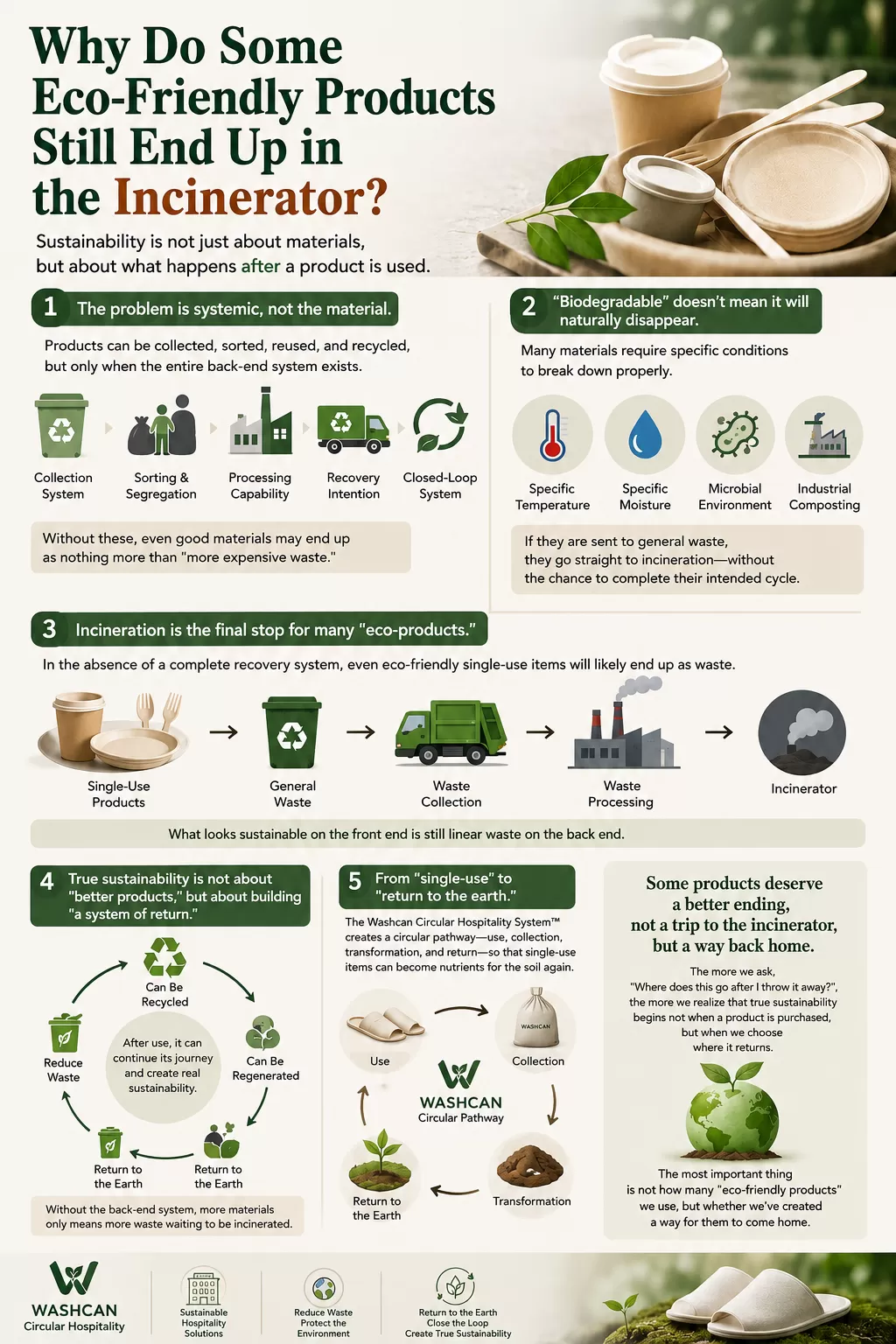
Why Do Some Eco-Friendly Products Still End Up in the Incinerator?
Many eco-friendly products are designed to reduce environmental impact, yet many still end up in incinerators after use. The issue is often not the material itself, but the lack of collection, recovery, and regeneration systems. Labels such as "biodegradable" or "compostable" do not guarantee that a product will naturally disappear. Without the right infrastructure, even sustainable products can become waste. This article explores the difference between sustainable materials and sustainable syst
Why Do Some Eco-Friendly Products Still End Up in the Incinerator?
Many people assume that if a product is labeled as:
・Eco-friendly
・Biodegradable
・Compostable
・Sustainable
it will naturally disappear after use.
But in reality, that is often not what happens.
Many products marketed as environmentally friendly still end up being treated as ordinary waste and sent directly to an incinerator.
The issue is not always the material itself.
More often, the problem is what happens after the product is discarded.
The Problem Isn't Always the Material — It's the System
When evaluating sustainability, people often focus on one question:
"What is this product made of?"
But an equally important question is:
"Where does this product go after use?"
Whether a product can truly be recycled, composted, or regenerated depends on much more than the material.
It depends on whether there is:
・A collection system
・Proper waste sorting
・Processing infrastructure
・Recovery capabilities
・A viable circular pathway
Without these elements, even the most environmentally friendly material may ultimately become nothing more than:
『a more expensive form of waste.』
"Biodegradable" Does Not Mean It Will Simply Disappear
oday, many products carry labels such as:
・Biodegradable
・Compostable
・Bio-based
・Environmentally friendly
However, these terms are often misunderstood.
Many biodegradable materials require:
・Specific temperatures
・Controlled moisture levels
・Active microbial environments
・Industrial composting facilities
to break down as intended.
If these products are discarded into general waste streams and transported directly to an incinerator, they never have the opportunity to complete the cycle they were designed for.
Incineration Has Become the Final Destination for Many "Green" Products
In many regions, waste management systems are still largely linear.
This is especially true in industries such as:
・Hospitality
・Food service
・Transportation
・Events and tourism
where large volumes of disposable products are used every day.
Even when conventional products are replaced with environmentally preferable alternatives, the outcome may remain unchanged if there is no collection and recovery system behind them.
As a result:
The front end appears sustainable.
The back end remains waste.
Sustainability Is Not Just About Better Products
True sustainability is not simply about manufacturing products with better materials.
It is about creating systems that allow products to continue their journey after use.
The most important questions are:
・Can it be recovered?
・Can it be transformed?
・Can it return to the soil?
・Can it become a resource again?
・Can waste be prevented rather than simply delayed?
Because without a pathway for recovery, many so-called sustainable products may only postpone their trip to the incinerator.
From Single Use to Soil Regeneration
This is one of the core ideas behind the Washcan Circular Hospitality System™.
We believe sustainability should not end at the point of use.
Instead, products should be designed with a second life in mind.
By creating pathways for:
『Use → Collection → Transformation → Regeneration』
materials can remain part of a continuous cycle rather than becoming waste.
The goal is not simply to reduce environmental impact.
The goal is to create systems where materials can contribute to new life, new resources, and healthier ecosystems.
Some Products Deserve a Better Ending
As more people begin asking:
"Where does this product go after I throw it away?"
the conversation shifts from sustainability as a product feature to sustainability as a system.
Because the future of sustainability may not depend on how many eco-friendly products we use.
It may depend on whether we have created a way for them to come home.
Conclusion
Many environmentally friendly products still end up in incinerators—not because they are poorly designed, but because the systems needed to recover and regenerate them do not exist.
The future of circular economy is not simply about better materials.
It is about building the infrastructure, partnerships, and pathways that allow materials to remain valuable long after their first use.
『Sustainability begins not when a product is purchased, but when we decide what happens next.』