What Happens to a Hotel Slipper After Checkout? Inside Taiwan's Circular Hospitality Revolution | Washcan瓦士肯
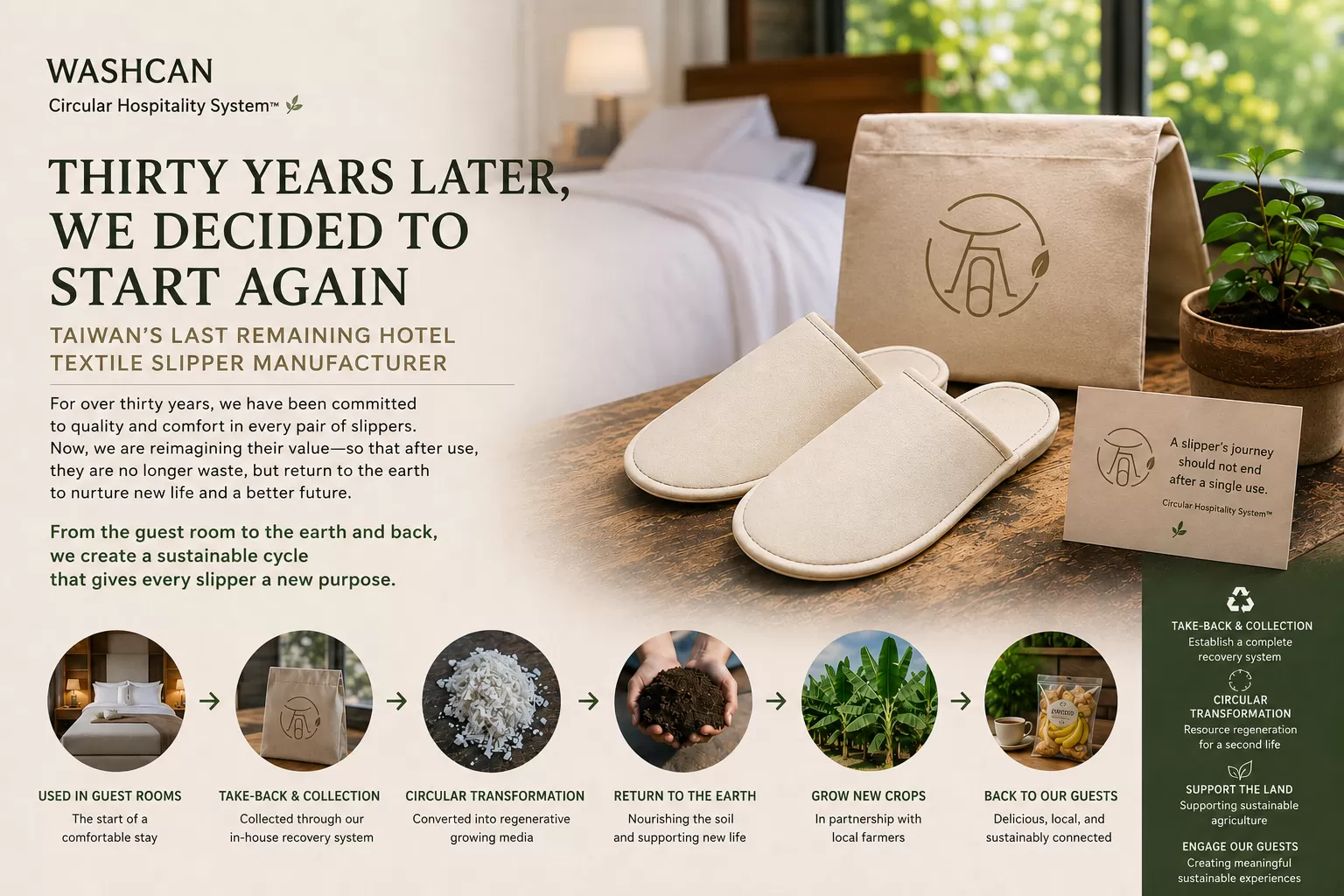
Thirty Years Later, We Decided to Start Again
For more than thirty years, Washcan has manufactured hotel textile slippers in Taiwan. As the industry gradually disappeared, we chose a different path—not just making slippers, but rethinking what happens after they are used. This story explores how a traditional manufacturer transformed into a Circular Hospitality solution, turning used hotel slippers into regenerative resources that support agriculture, soil restoration, and a more sustainable future for hospitality.
Thirty Years Later, We Decided to Start Again
The Last Remaining Hotel Textile Slipper Manufacturer in Taiwan
Sometimes, an industry does not disappear overnight.
Instead, it slowly fades away, unnoticed by most people.
There was a time when Taiwan was home to many manufacturers producing hotel slippers. They supplied hotels across the country and supported the growth of Taiwan’s tourism industry during its most prosperous years.
As globalization accelerated and price competition intensified, many factories relocated overseas, transformed their businesses, or quietly closed their doors.
One day, we realized something surprising:
Very few manufacturers in Taiwan were still willing to make textile hotel slippers.
Washcan is one of them.
We Didn't Suddenly Decide to Pursue Sustainability
After more than thirty years of making slippers, we began asking ourselves a different question:
『What happens to a slipper after it is used?』
For decades, the industry focused on:
・Material selection
・Manufacturing cost
・Lead time
・Comfort
・Product quality
But rarely on what comes next.
After a guest checks out, where does that slipper go?
To an incinerator?
A landfill?
The ocean?
Or simply somewhere no one thinks about anymore?
We realized that the real challenge was not how products are made.
The real challenge was how they end.
Hospitality Generates More Waste Than Most People Realize
Every year, Taiwan's hospitality industry uses tens of millions of disposable hotel slippers.
Individually, they seem insignificant.
Lightweight.
Low-cost.
Easy to overlook.
But when multiplied across an entire industry, they become a significant waste stream.
Most disposable slippers ultimately end up being incinerated.
That led us to ask:
『What if a slipper didn't have to become waste after a single use?』
Redesigning the Life Cycle of a Slipper
At Washcan, we didn't want to simply create a "more sustainable slipper."
Because sustainability is not just about changing materials.
The harder questions are:
・How is the product collected after use?
・Who manages the recovery process?
・Can the material truly return to a meaningful next life?
These questions inspired the development of the
『Washcan Circular Hospitality System™』.
The journey begins in a hotel room.
After guests check out, used slippers are collected and recovered through Washcan's dedicated recycling system.
The materials are then transformed into regenerative growing media and soil resources.
Instead of ending as waste, they return to the earth.
From Hotel Rooms to Farmland
Over the past few years, Washcan has worked closely with agricultural partners in Taiwan.
Including local farming communities and the Nantou County Fruit and Vegetable Production Cooperative, representing 34 farmers committed to environmentally friendly agriculture.
Materials once considered waste are now supporting:
・Banana cultivation
・Tea production
・Agricultural growing media
・Soil regeneration
The story does not end there.
The harvest can eventually return to hospitality spaces as local products, snacks, beverages, and meaningful guest experiences.
What was once discarded becomes part of a new cycle.
Hospitality Doesn't Need More ESG Reports
It Needs ESG That Guests Can Experience
Many hotels have already started making sustainability improvements.
They have reduced single-use amenities.
Removed disposable toothbrushes.
Introduced refillable dispensers.
These are important steps.
But many guests never truly notice them.
Because sustainability often remains hidden behind policies and operations.
We believe hospitality needs something more tangible.
Something guests can see.
Something guests can feel.
A slipper should not be remembered as a disposable amenity.
It should become part of a story worth sharing.
Thirty Years Later, We Decided to Start Again
Many people believe a factory's purpose is simply to manufacture products.
We see it differently.
The real responsibility is adapting to the challenges of a changing world.
Thirty years ago, we made slippers.
Today, we are reimagining what those slippers can become.
If manufacturing can evolve into regeneration,
If waste can become a resource,
If hospitality can become part of a circular system,
Then perhaps a slipper's value extends far beyond a single stay.
Washcan never left the industry.
We simply decided to start again.
Conclusion
Some products end when they are used.
Others continue their journey.
From hotel rooms.
To recovery.
To soil.
To farms.
And eventually back into people's lives.
This is the future Washcan believes in.
Not producing more things.
But creating systems where materials can continue to exist, contribute, and regenerate.
Because a slipper was never meant to become waste.
It was made to regenerate.
Made To Regenerate™
Washcan Circular Hospitality System™